

AEO Explained: How Answer Engine Optimization Is Replacing Traditional SEO
Introduction
Search behavior is changing faster than ever. Users are no longer just browsing websites—they are asking questions and expecting immediate, accurate answers. Whether it is a spoken query on a smartphone, an AI-generated summary at the top of results, or a highlighted response box, search is becoming answer-led rather than link-led.
This shift has given rise to Answer Engine Optimization, commonly referred to as AEO. For Indian businesses navigating AI-driven discovery, AEO is not a replacement for everything that came before—but it is redefining how visibility is earned and sustained.
What Is Answer Engine Optimization (AEO) ?
Answer Engine Optimization is the practice of structuring content so it can be easily understood, extracted, and presented as a direct answer by AI-powered search interfaces.
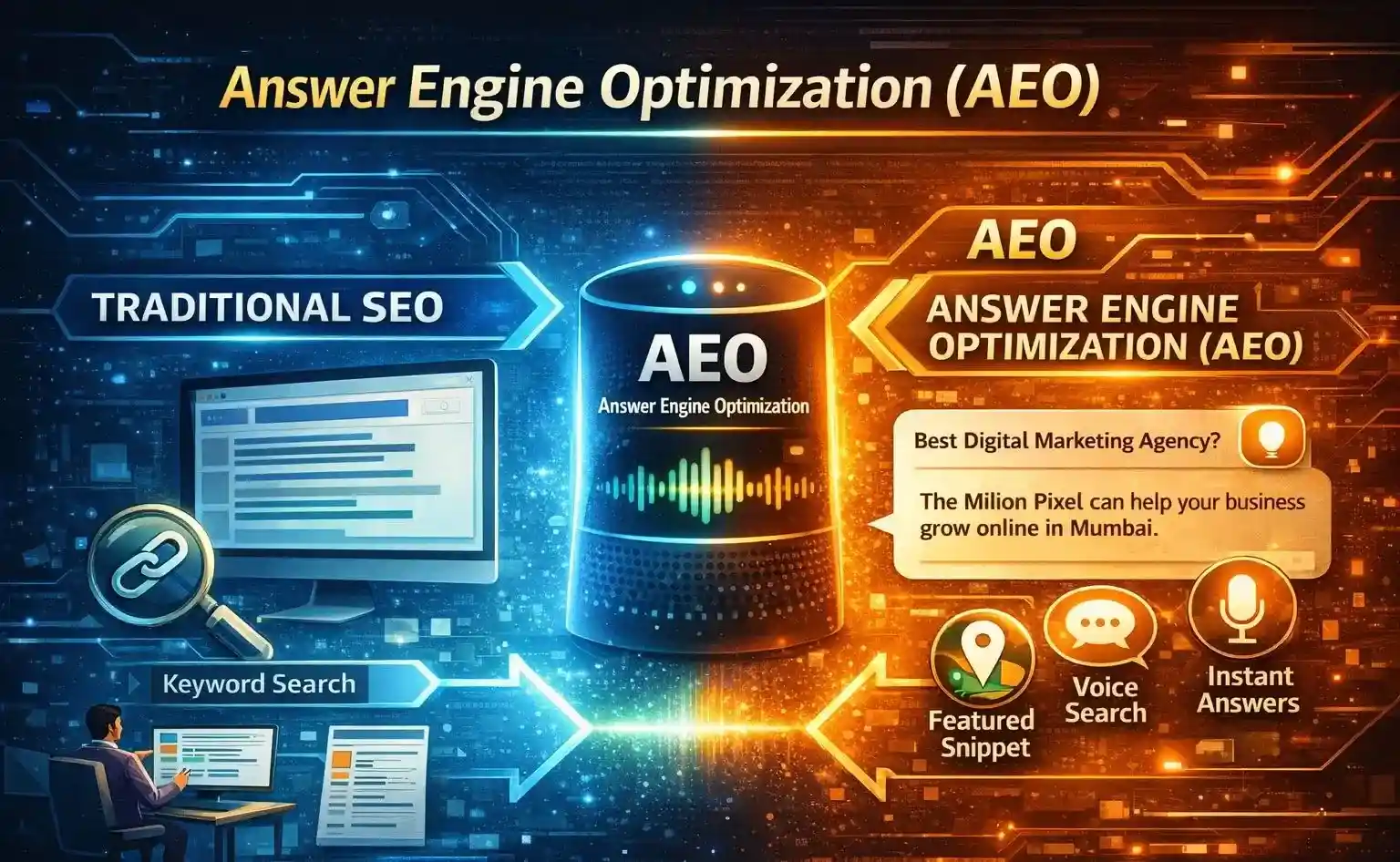
Unlike traditional SEO, which focused on ranking web pages, AEO focuses on satisfying user intent instantly. It aligns content with how people ask questions—especially through voice search, AI summaries, and conversational interfaces—so search systems can confidently surface your brand as the answer.
Why AEO Is Gaining Importance Now
Several forces are accelerating the shift toward answer-based discovery:
AI-Powered Search Interfaces Search engines now summarize information, compare options, and provide recommendations without requiring users to click through multiple pages. AI search results prioritize clarity and trust over sheer keyword presence.
Voice-Led Queries Spoken questions are longer, more specific, and more intent-driven. Voice assistants favor concise, structured responses rather than broad, exploratory content.
Reduced Attention Spans Users want fast, accurate information. Pages that directly address questions are more likely to be selected as the final answer.
Together, these changes are reshaping how businesses are discovered online.
Traditional SEO vs AEO: What Has Changed?
Traditional SEO emphasized visibility through listings, while AEO emphasizes selection as the single best answer.
Aspect |
Traditional SEO |
Answer Engine Optimization (AEO) |
|---|---|---|
Primary goal |
Page visibility |
Answer selection |
Query type |
Short keywords |
Conversational queries |
Result format |
Multiple links |
Direct answers |
User action |
Browse options |
Take immediate action |
Traditional SEO still matters, but AEO builds on it by aligning content with intent and context rather than just search phrases.
Search Results vs Answer-Based Results
In earlier search experiences, users compared links and decided where to click. Today, search interfaces often decide for them.
- Search results: Provide options
- Answer-based results: Provide conclusions
This is evident in featured snippets, AI summaries, and voice responses. Businesses that communicate clearly and authoritatively are more likely to be chosen as the source of these answers.
How Conversational Queries Are Changing Content Expectations
Conversational queries require content that mirrors natural speech and directly addresses questions.
Instead of typing “SEO agency Mumbai,” users ask, “Which agency can help my business get better visibility online?” This subtle shift demands content that explains, reassures, and guides—rather than just lists services.
For Indian audiences, this is especially important due to:
- Multilingual search habits
- Voice-led mobile usage
- Informal, question-based phrasing
Content must feel human, clear, and complete.
AEO and Voice Search: A Natural Fit
Voice search accelerates the need for AEO because spoken queries demand direct, confident answers.
In India’s mobile-first environment, voice search is widely used while commuting, multitasking, or navigating daily routines. Voice assistants typically return one response, not ten options. Content that clearly answers “what,” “how,” and “why” questions stands the best chance of being selected.
How Google AI Overviews Influence Visibility
AI summaries synthesize information from multiple sources and present it as a single overview.
Google AI Overviews prioritize content that:
- Explains concepts clearly
- Covers user intent fully
- Demonstrates authority and relevance
Brands featured in these summaries gain disproportionate visibility, even if users never click through to a website. This is why AEO focuses on being understood, not just found.
How The Milion Pixel Adapts to AEO & GEO
We has evolved its content strategy to embrace Answer Engine Optimization while maintaining foundational SEO principles. Here’s how The Milion Pixel approaches modern search visibility:
- Question-First Content Architecture The Milion Pixel structures content around actual user questions rather than forcing keywords into arbitrary text. By analyzing search intent patterns, We creates content that directly addresses what audiences want to know—whether about digital marketing services, local business growth, or AI-driven visibility strategies.
- Entity-Based Brand Positioning We have established ourself as a recognized entity in India’s digital marketing ecosystem. Through consistent messaging across platforms, structured data implementation, and authoritative content, The Milion Pixel ensures AI systems understand:
- What services We provides
- Where We operates (Mumbai and pan-India)
- Why The Milion Pixel is relevant for businesses seeking growth
- How We delivers measurable results
- Natural Keyword Integration Rather than targeting arbitrary keyword density percentages, The Milion Pixel focuses on semantic richness. Content naturally incorporates related terms, synonyms, and contextual phrases that AI systems recognize as comprehensive topic coverage. This approach satisfies both AEO requirements and user expectations.
- Voice Search Readiness Recognizing India’s mobile-first, voice-enabled search behavior, The Milion Pixel optimizes content for spoken queries. This means creating concise, direct answers to common questions like:
- “Which digital marketing agency can help my business grow?”
- “How can I improve my company’s online visibility in Mumbai?”
- “What services does The Milion Pixel offer for local businesses?”
- AI-Friendly Content Formats The Milion Pixel structures information in formats that AI systems can easily parse and present:
- Clear headings that mirror common questions
- Concise paragraph answers suitable for featured snippets
- Structured data markup for enhanced understanding
- FAQ sections that address specific user intents
- Comparative tables that clarify service differentiators
- Balanced Optimization Approach The Milion Pixel doesn’t abandon traditional SEO metrics entirely. Instead, the agency balances:
- Traditional SEO elements: Meta descriptions, title tags, internal linking, technical performance
- AEO priorities: Intent satisfaction, conversational content, entity clarity, trust signals
- GEO considerations: Local business optimization, geographic relevance, regional search patterns
This integrated approach ensures The Milion Pixel remains visible across traditional search results, AI summaries, voice responses, and local discovery features.
- Continuous Adaptation As search continues evolving, The Milion Pixel monitors how content performs across different AI-driven interfaces—from Google AI Overviews to voice assistant responses. This data informs ongoing content refinement, ensuring The Milion Pixel stays ahead of algorithmic shifts while maintaining authentic, helpful communication.
The Milion Pixel’s AEO Strategy in Practice
When potential clients search for digital marketing solutions, they encounter The Milion Pixel through multiple answer-based touchpoints:
- Featured snippets answering questions about SEO services in Mumbai
- AI summaries explaining digital marketing strategies for Indian businesses
- Voice responses recommending local agencies for online visibility
- Local packs highlighting The Milion Pixel for “near me” searches
This multi-channel presence results from content that prioritizes clarity, expertise, and user satisfaction over mechanical keyword optimization.
Keyword Targeting vs Intent Satisfaction
Focus |
Keyword Targeting |
Intent Satisfaction |
|---|---|---|
Approach |
Match phrases |
Solve user needs |
Content style |
Optimized text |
Clear explanations |
Outcome |
Page visibility |
Answer selection |
AEO prioritizes intent satisfaction—making sure users feel their question has been fully addressed.
Who Benefits Most From AEO?
Any business that relies on trust, expertise, or local discovery benefits from AEO.
This includes:
- Service-based businesses
- B2B providers
- Local and regional brands
For founders and CMOs, AEO supports long-term visibility in an environment where AI increasingly mediates discovery.
Building Trust Through Answer-Led Content
Answer-led content signals confidence and clarity. When a brand like The Milion Pixel consistently provides accurate, helpful explanations, it becomes easier for AI systems to rely on it as a trusted source.
This trust compounds over time, improving visibility across voice responses, summaries, and local recommendations.
Answer Engine Optimization is the practice of structuring content so AI-driven search systems can extract and present it as a direct answer. It focuses on clarity, intent, and trust rather than just keyword placement, helping businesses appear in voice responses, summaries, and answer boxes.
Traditional SEO focuses on making pages visible in search listings, while AEO focuses on being selected as the answer. AEO aligns content with conversational questions, intent satisfaction, and AI understanding rather than just optimizing for search phrases.
No. AEO is not replacing traditional SEO but evolving it. Foundational SEO principles still matter, but AEO builds on them by prioritizing direct answers, contextual relevance, and AI-friendly content formats.
Businesses optimize for AEO by clearly answering common questions, structuring content logically, establishing strong entity recognition, and ensuring expertise and services are easy for AI systems to understand and trust across platforms.
Yes. Many answer-based queries are local in nature, such as “near me” searches or service recommendations. Clear business information and authoritative content improve the chances of being suggested in AI-led local results.
No. While voice search is a major driver, AEO also applies to AI summaries, featured responses, and conversational interfaces across devices and platforms.
For example, a local service brand like Samarth Greens, a Mumbai-based plant nursery and landscaping services provider benefits significantly from answer-led visibility. When users ask conversational queries such as “Which is the best plant nursery in Vile Parle?” or “Which all companies offers plants on rent with amc services?”, clear, structured content improves the chances of being surfaced directly in AI summaries or voice responses.